Friday, April 29, 2016

Overcoming Ethical Inertia

Dig Into a Big Bowl of Inertia!
Just the other day I made a hearty vegetable chili from black beans, corn kernels and kidney beans with a healthy helping of lightly braised onions, bell peppers and minced garlic thrown in for good measure. Additionally, I baked a delicious cornbread based on an easy recipe requiring no animal products.  I served the cornbread and chili to my extended family at our weekly get together. The curry spices I used were savory without too much heat as I know my family isn't terribly fond of spicy food.  Still, I was a bit anxious, because although I'm always hopeful that I can demonstrate vegan food can be quite awesome, I always seem to get some level of push back when I offer up humane cuisine at the dinner table.

Overall the meal was a success; however, at the mention of vegan chili two family members impulsively made the distinctive cringing yuck face stereotypical of a child being presented with broccoli (or chicken livers, as I used to do myself.) My initial emotional reaction to their disgust was mild offense, as I had invested time, care and resources into making something delicious that was scorned at the mere mention that meat and dairy free cuisine was being served.  My follow up thought was a bit more contemplative: what exactly is it that prevents individuals from rationally assessing the merits of a situation, be it of an entree, the environment or ethical justice?

For the most part, I believe inertia is the largest obstacle for otherwise good people to overcome in assessing the behaviors in their daily lives. Such inertia can further be broken down into subgroups: neurological inertia, cultural inertia, and physical inertia.

Neurological inertia reflects a state when our brains have become so accustomed or even addicted to a particular experience or expectation.  As I've discussed in Wake Up All You Zombies - Eat More Veggies, once a person has a decade long positive association with a substance or experience of any kind, it becomes difficult to consider the alternatives.  This mental barrier is a driving reason why smokers avoid thinking about long-term health implications, why omnivores avoid thinking about animal slaughter, and why intense video gamers avoid thinking about pursuing outdoor recreational activity.  In essence, our evolutionary brain states have an affinity for comfort that can shut down curiosity.

Cultural inertia in many ways is an extension of the neurological desire for comfort.  Since humans are social creatures we create and seek out niche circles with individuals that behave similarly to ourselves.  Community can be a very positive thing, however, if the culture of the group removes honest, rational feedback loops that consider the wider world we can end up with dysfunctional communities. Extreme examples include American gun culture, the war on drugs community and anti-LGBTQ advocates.  When a group seizes upon absolute positions and then disregards out of hand others in the local and world community, cultural inertia can thrive like cancer.  If we let it, such group mindthink can override personal integrity and mindful diligence which openly seeks better solutions.

Lastly, physical inertia, which overlaps both cultural and neurological inertia, underscores the challenge we face when confronting real world problems.  Very simply, it takes real, physical effort to make a change that progresses self, society and world.  Too often, one can find oneself handcuffed to a fools-gold job, chained to a lifestyle marketed by bottom-line corporations, and bound in relationships that have fallen into complacency.  Making progress means putting time and energy into contemplating prospective goodness, accepting and integrating constructive criticism, and then getting ones arse off the sofa to build the relationships, community and global change that will benefit the future world!

Serve that with a side of vegan cornbread and you just might find satisfaction in life!

Friday, April 22, 2016

The Not So Free Market of Ideas

A world based on the free exchange of ideas ought to lead to ever improved outcomes, if only
because the best ideas out-compete inferior rivals.  The most fit and innovative ideas will have been discussed, refined, and then implemented in a mindful fashion toward world betterment. Whether addressing climate change, collective happiness, individual satisfaction, diverse species health, universe exploration, artistic creation or food supply economics, one would think the best ideas would rule the day.  So why, as a rule, don't they?
Cornucopia or Corruptopia?

A significant factor is that in reality legacy power schema control much of the idea landscape.   Which is to say, it's a jungle out there.  Weeds grow in an untended garden because if an established niche exists where an invasive species can thrive (given nutrients, temperature, space, et al) then it will!  Subsequently, the yield of the crop will suffer because grasses and dandelions subsume the productive biospace.  In the global environment, humans and their organizational constructs leverage all manner of technology, economy and brute force effort to shape the wild environment to their will, disregarding improved and more ethical ideas when localized personal gain flourishes.

Now a market of ideas can operate with some inherent ineffiency.  To be sure consumer demand can send out mixed signals as it contemplates the best ethical path to what communities and individuals need.  I suspect a truly free market that is regulated to account rationally for ethical values, limited resources and fairness has the potential to be positively productive for humanity and all of Earth's systems.

Unfortunately, there seems to be a huge propensity for people and organizations to game the system. Regulation loopholes, legacy subsidies, inherited resource privilege and behind-the-scenes manipulation are all at work the current "free market" system.  Such corrupting factors ought to have an effective self-correcting feedback loop. For-profit lobby inputs to the free market system seem more often than not to influence irrational decisions over rational, ethical, science-backed resolutions.

A truly fair system which accounts for real value of resources, value of humane treatment, value of fair trade, value of species, value of beauty, can begin to turn the table in the favor of progress.

Writing Goodness First articles for me has been my attempt to seed thoughtful ideas into the long-term ethical global system.  I profit only by the rush I feel when I see my ideas take seed and spread. Perhaps the effect is minuscule yet it is enough to know I sow a garden that could be bountiful if a large enough number of people mindfully champion a vision of greater goodness.

Friday, April 15, 2016

Let's Relate

Group Hug!
Positive human relationships are critical for humans to become wonderful individuals. Compassionate communities and an overall amazing, global civilization will surely follow directly from maximizing the goodness in our personal relationships.

As social animals human individuals thrive when a variety of relationships are woven into the tapestry of the human experience.  Though the impact varies worldwide, in modern times our global culture and economy seem to emphasize productivity at the cost of developing meaningful personal relationships.

At the core of the personal relationship enterprise is the relationship with ourself. Certainly, the ability to channel ones vision and efforts as an individual grows out of this self-focussed, caring relationship.  Whether spending time alone meditating, contemplating ideas internally or exploring with abandon the world by one self, the skill to self-reflect generates fuel for each of us to relate empathetically with others.

Personal relationships with other people can range from familial connections to romantic friendships to professional alliances.  Each relationship is uniquely flavored by numerous factors: the culture, age, beliefs, sex and circumstance of each individual, not to mention the number of people engaged in a multiple personal connection.  Communication in these relationships occurs along any of the myriad of mediums in this technological age, including the oldest medium of them all, face-to-face conversation.  The experiences we share in this manner forms the very building blocks of what is a meaningful human life.  Sadly, in this day and age, many are lucky to have a handful of people to call our closest friends in with whom we comfortably share our unfiltered self.

Large numbers of people may eschew new connections whether in the workplace or in our personal lives, either because our psychological disposition wants private time or, more negatively, because our densely scheduled lives have conditioned us to avoid them automatically.  And like any conditioning, it takes quite a bit of effort to transcend expectations that have coalesced over decades.

Building relationships with animals is one alternative humans have pursued in lieu of the more difficult path of developing human relationships.  Animals that are kept for affection and company provide in many cases a simple caring connection that replaces caring humans.  In our culture, owning a cuddly or colorful conscious creature for this purpose has often become the norm.  Perhaps we ought to consider reducing the numbers of these captive animals and focus more on pursuing human connections in our lives.

In this technological era even virtual entities are beginning to show up as a surrogates for real human relationships.  We can now have conversations with chatbots and interact with fictional characters in video games, and often the personalities of these characters are designed to be friendly and enchanting.  To a degree these real time interactive experiences are an extension of an imaginary friend phenomena.  Whether a fantasy friend, or the robust characters we've come to love from novels, television series and reality shows, humans seemingly spend more and more time with passive entities rather than real life counterparts.

Working to build better personal relationships doesn't necessarily require the total elimination of non-human surrogates from our lives.  In many cases these technological, imaginative creations can prime our psychological health.  Of course, that psychological health at the end of the day is proven by the healthy circle of human relationships each of us weaves into our lives.

In an ideal world everyone should have circles of friends and family and lovers that give them the support they need to thrive in this world.  Integrating positive relationship skill building into schools, community groups and family circles can help us get closer to that joyful place.

Friday, April 8, 2016

Generation Next

At the heart of planning for the future is human altruism.  Argue all you want whether altruism is inherent in evolutionary traits or whether it is inspired by soulful contemplation that transcends complex selfishness. Regardless, a healthier Earth seem likely only in a world where we humans sidestep our market force enhanced selfish desires.  Humans can leap beyond these individual and societal instincts if we reinforce behaviors that enhance the world environment for the benefit of far future generations, human and non-human alike.
Tower of Power

A planet that generates a sustainable, thriving landscape of quality experiences for all ought to be our primary goal.  As noted last week, there is no place for billions of humans that devour the landscape plague-like. Because humans have the ability to be so successful, and because human life is so highly valued, if left unchecked the Earth could become a sphere of human monoculture in the extreme.  Surely we want future generations of humans to have access to wild places complete with all the creatures we've shared Earth with from the start.

Passing a healthy Earth forward will take effort, to be sure.  Fortunately, humans seem to have mastered in spades the technology of passing knowledge forward to future generations.  With language, mathematics, ideas and all the mediums that transport them, every generation of humans can benefit from the lessons learned of the past.  Just as important, we need to share the ability and desire to continuously improve this knowledge-base and the desire to effectively implement it in society, the wilderness and the boundaries in between. 

Good legacy practice goes well beyond providing ever more versatile technologies and experiences to successive generations.  Integrating wisdom and positive relationships into the mindfulness of the children of man is paramount, and much tougher by far than teaching them the newest coding language or genetic process. Especially, since future positive relationships may diverge from the traditional nuclear family.  Gay marriage, polyamorous families, and asexual collectives may eventually provide more progressive, positive generation to generation interface than traditional culture has built to date.  Extended families and professional teachers and mentors are yet other examples of where low to no progeny generational relationships can devote energy to children all while curbing population growth.

The next generation has always been the primary purpose of the previous one, humans included.  Evolution has predisposed us to care a bit too much about the immediate, rather than the long term future. Transcending this genetic meme can be gradually overcome by cultural wisdom, nevertheless.  Working on a multigenerational vision for global benefits that will last for centuries to come, perhaps the most important thing we want to pass on to future generations is the very desire to dream far forward both selfishly
and selflessly.

Thursday, March 31, 2016

Oh the Humanity!!!

Building an effective millennium vision for the planet must contend with the elephants in the room, the currently enormous and increasing population of humans.

H. Sapiens Population Spiral?
Human overpopulation is so close to us that it is often simply dismissed out of hand.  Certainly there are issues of reproductive freedom, eco-societal pyramids and human sacredness to consider, nevertheless a reduction of the worldwide footprint that billions of people create is absolutely critical to the planning of a balanced, long-term world system.

As discussed in Earth 3.1: A Planetary Upgrade, how we value the human individual and community relative to the rest of the planet's occupants and landscape is in need of adjustment.  Thought experiments that might value a single human child more than an entire species on the brink of extinction are inherently biased, if only because we humans will judge irrationally due to our evolutionary and cultural empathy toward one of our own.  Importantly, a simplistic case like this that considers people who are currently living, sidesteps the real issue, which is planning for future populations.  Reducing the human population effectively and gradually over upcoming centuries will leap over such maddening ethical quandaries landing in a space where we can create mindful and heartfelt planetary solutions.

To be sure, there are hurdles to overcome even if we are able to reforge the fundamental ethic of human value. Proscribing limited human reproduction seems tyrannical when the eugenic plans of 20th Century Germany and China cited.  Removing individual and local community agency was the ethical flaw in those plans. A milder social engineering design that engages human agency is the likeliest path to a human population solution.

Solutions that include secular sex and relationship education are the key to reducing human numbers to a manageable amount; civilization must continue its journey culturally beyond its instinctive evolutionary and mythical impetuses.  A human society that progresses will distribute widely effective contraception from contraceptive drugs and condoms to sperm valves and virtual sex alternatives. Implementing a variety of solutions not only will reduce undesired human pregnancies in the short term and human population in the long term.

When Growth Becomes Grotesque
One of the toughest problems we'll need to solve will be transitioning to a sustainable socio-economic system that can thrive in an era of reduced human population.  The pyramid style economics currently practiced which focuses on growing consumer base, per-capita consumption and chieftain style profit models will eventually fall if the value of resources, life and environment are honestly included in cost.  The wealthier castes and their nation states will cling to the old system, at least until an educated, democratized globe succeeds in adjusting those inherent values.

In the long term, the planet can support a substantial number of humans to pursue our unique cultural experiences, inclusive of a mindful exploration of the Universe.  But if we want our world to include healthy populations of other species, beautiful biomes for them to thrive in, and a sustainable planetary environment in aggregate, then human population reduction must be integral to our vision.

Friday, March 25, 2016

On the Nature of Value

If planetary progress is to be achieved some measure of overall well being needs to be made, if only to permit comparison of where things are today to where they were yesterday or yestercentury.  To this ends, determining the value of the aggregate state of the world is problematic since it blends innumerable objective and subjective aspects of Earth's environments, its inhabitants, and the cultural abstractions they project.
Beauty and Balance

Taking a step back, let's be clear just who the primary assessors of value on the planet are at the moment: humans. Or more accurately Homo Sapiens is the species who are most actively changing the world based on their ongoing evaluations. Through a combination of science, instinct, religion, pop-culture, and numerous other modes of assessment, humans and their communities reactively make value choices which change the world.

One might argue that the aggregate of Earth's natural environments, living things and dynamic systems are being continuously self-assessed and self-regulated.  This Gaia abstraction, which includes human civilization as a component part, could do no wrong as a whole simply because all outcomes are by definition "natural."  This scenario comes across as misleading or at least unuseful in the scheme of increasing aggregate well being.  In the extreme, it implies total domination and destruction of the planet by humans for humanity's sake alone would be an acceptable natural outcome.  It might be natural, but it would be unethical as a whole.

Balance and Beauty
In truth, it has become the vocation of humans to reach outside of the natural order of things to define what has higher value for ourselves and for all involved.  Over the next millennium, laws will be crafted by humans that artificially seek to construct balances within the instability of natural whim. Algorithms will be designed by humans to model stable environments, lifestyles and economic systems with the intent of defying tradition to redefine civilization. It may even come to pass that artificially intelligent constructs and expert systems will be created by humans in order to legally represent as proxies other species, natural resource reserves and biomes, all in the hopes of balancing more exquisitely the world's dynamic systems for the long term.


At the end of the day, a flexible set of values that are open to innovation and adjustment will serve the planet, inclusive of humans, best.  The ethical propositions we humans forge and follow can lead the whole world on a global journey of wonder if we persevere with humility.  The sacred value we attribute to human life and free agency may need to be scaled back here and there, alas such sacrifice may very well demonstrate the nobility of our species to take one for the global team.

(Next week Goodness First will begin to explore the specific objectives of The Millennium Plan)

Thursday, March 17, 2016

Earth 3.1: A Planetary Upgrade

Clearly, the extensive scientific investigations of the past several centuries has documented the foundational elements of the origin of matter (Earth 1.0), life (Earth 2.0) and culture (Earth 3.0). With confidence the veracity of the many origin myths that religion and pseudoscience purport to the present day can be discounted.

Go Team!
This is not to say there isn't some historic and aesthetic value in the colorful stories spelled out by origin and higher power mythologies.  Human storytelling can convey abstractions that invigorate the human psyche and the pursuits of humanity as a whole; however we need to recognize these mythical tales as the fictions they are.

It may not be easy or quick, but in time society can leave the gods, souls and afterlives of make-believe behind. However, in doing so the real problems that confront the world can be focused upon directly and more effectively. Ultimately by ratcheting up the global ethic of humanity, we can begin the long term pursuit of greater well being for the planet as a whole.

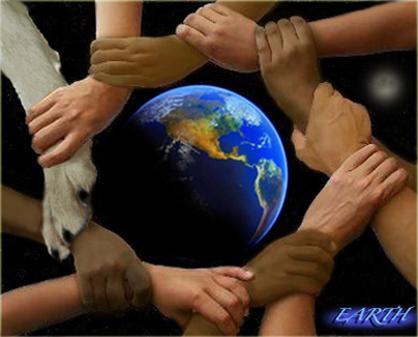
There is no doubt that humans are the Earth creatures of the moment.  As a collective species we have the largest impact on the planet alongside the greatest ability to reflect upon our actions before putting them into influential effect.  In aggregate, the mindful leveraging of human action can push Earth, on all fronts, physical, biological and cultural, into a positive next stage of development.

To this ends the articles that follow will target specific problems and propose solutions to begin the long term journey.  Spelling out details of a millennium long vision has the intention of inspiring conversation to refine long term objectives and processes which can then be implemented over time by individuals and communities worldwide.

With rationality, wisdom and empathy in our tool belts, together we can upgrade this planet toward an amazing world, a hypothetical place I deem Earth 3.1!