Friday, October 16, 2015

Joy = Tomato ( π )

Sir Slicealot at Your Service!

In days of yore, there was evil rampant upon the land that threatened the very existence of the kingdom. Villagers from the surrounding countryside gathered at the castle's gates to appeal to the wisdom of the good king.  Under the circumstances extreme measures were called for so their leader gathered his knights around the celebrated round table to deliberate.  After hours of heated discussion the king erupted upon the high terrace and announced with great aplomb to his concerned citizens: "Let's have a pizza party!"

And so all the residents of the land, rich and poor, young and old, invited their would-be evil fellow humans to throw down their weapons and join in the celebration of deliciousness that is pizza! Baked into doughy disks decorated with delicious toppings, pizza was the round table-fare of the people.  And so the war was ended and much consumption was had and plenty of merriment foisted with joyful laughter forever after.

Nothing quite says community like a pizza party!

Whether celebrating a recent victory, thanking friends who kicked in painting your house, or just because a group of famished acquaintances happen to be in arm's length of a a Pizza Hut app, pizza symbolizes the pinnacle of civilization.  Organizing an order, negotiating toppings, anticipating delivery, splitting the bill and of course consuming the innocent round entree all contribute to the heart that is the very essence of being socially welcoming human beings.

One veggie-lovers with vegan mozzarella, please!


Friday, October 9, 2015

Fishing for Answers with Science

The Universe is full of complexity, an unfathomable array of factual states of energy and matter in constant flux across space and time. These factual data-points are, as a whole and even in the most specific atomic cases (thanks Mr. Heisenberg) fully unknowable.

In a sense we humans are but minuscule fish adrift in the great fish tank of Existence.
Something is very fishy about this idea!

Science to the rescue!

Fish we may be, but we are crafty fish.   We have devised the scientific method, a rational, systematic, self-correcting method by which we can identify useful patterns in the vast ocean of drifting detritus.

The scientific method, in its fundamental form, encourages the creation of a specific hypothesis based on observation and imagination.  (Goldfish are intelligent.)

Next under as controlled conditions as possible, the hypothesis is tested.  (A bowl of goldfish are given a calculus exam of the waterproof variety at 65 degrees Fahrenheit)

Data is collected through honest observation. (After two hours of exposure the goldfish nibble at the corners of the test)

Analysis of observation occurs leveraging mathematical modeling to quantify the outcome (Scoring of test reveals 0 of 100 points scored.)

Conclusions are then made (Goldfish are not intelligent...when it comes to calculus)

Of course, the most important aspect of science is that it takes a recursive path.  By reviewing past experiments and modifying them we can more effectively understand a given situation.  This essentially takes the form of tweaking the hypothesis, refining the test apparatus, data collection, and result formation.  To borrow a phrase "shake, bake, and repeat" (present fish excluded) until a more refined understanding is established.  In this way the scientific method over time can zero in on a truer picture of the world.

Refined Goldfish Hypothesis 2.0:  Goldfish are intelligent... in regards to Byzantine Empire history.

...of course silly hypotheses can lead us on a wild trout chase.

Friday, October 2, 2015

Sacredness Part I: Twisting Infinity into our Values


Squeezing the Infinite into a Rectangular Box
In the scheme of human perception we assign a range of values to things in this world.  A short example list of things with declining value might be: life, love, the environment, a tank of fuel, a chocolate bar, a pebble, a cockroach.  (implicit in this ordered list is the idea that values for a variety of things can be measured using the same units--a simplification to be sure)

Actual valuations, of course, will vary from individual to individual and within a larger context.   A pebble that is an emerald might be moved up on the list by those who value jewelry. Someone starving will likely move the chocolate bar to the head of the list.  And when talking about the life of a cockroach, the first and last items create a wrap-around paradox of sorts.

This subjective valuation causes a complexity of problems as humans attempt to integrate their "values" toward pursuing states of greater well being for themselves.  Perhaps, the greatest conundrum lies in the idea that certain things are sacred, essentially having infinite value.  Whether it is a sacred text, the sanctity of life itself, or the need to have coffee in the morning.   If we value something too highly, it has the potential to destroy things that have value in the attempt to preserve these sacred things.

More on this in the future as I consider possible solutions to how the delusional valuation of sacredness can be confronted.


Tuesday, September 22, 2015

Worlds Rewritten

As an aspiring author, I thoroughly enjoy the ability to create original stories.  Alas there is something compelling about writing fiction which continues an established author's work or creates a new story in that fictional Universe.

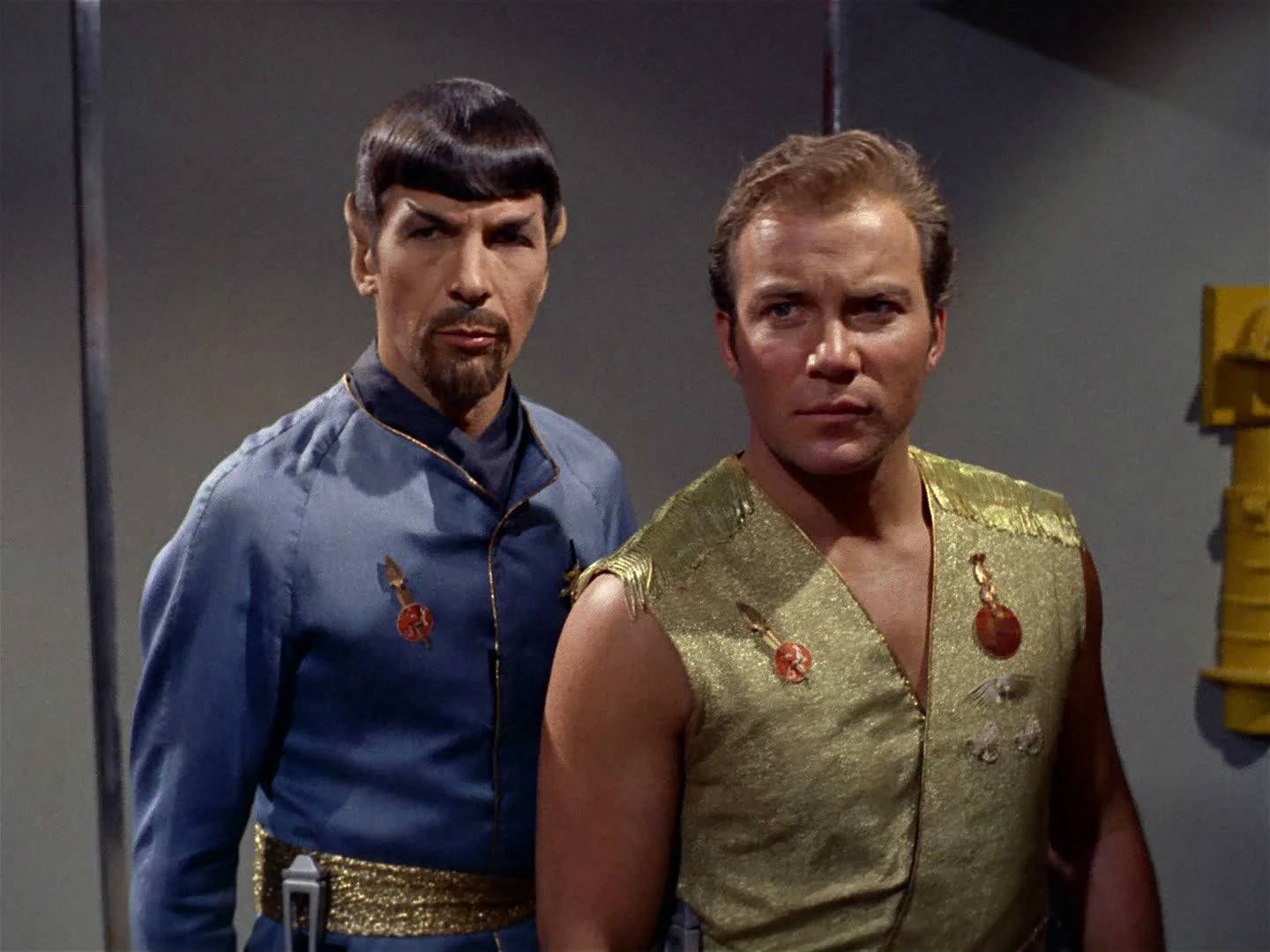
What if Spock had a goatee...
We see this genre of fan-written fiction (or "fanfic") in the popular culture aplenty. The recaptured fairy tales televised in Once Upon a Time and Grimm followed quick on the heals of the Fables graphic novels.  By weaving their magical plot-lines, these continuations connect us to the magical memories of our childhood with a desire to know what happens next and what happened before, often with adult themed implications. On the other hand, rebooted stories like the new Star Trek film series and the X-men movie prequels can look at alternate realities where things unraveled quite differently. In both cases the fanfic outcomes can be worthy experiences or total rot.

For me, writing fanfic usually takes the form of a short story length tale that speculates beyond an existing story ending that I found dissatisfying.  Perhaps it is hubris to attempt to tweak a tale to ones liking, alas what kind of world would it be where we didn't have the ability to change things, if only within our sphere.

To that end, or rather to three different ends, I present a trio of my fanfic entries for your consumption.  Certainly, I recommend reading the original source, each of which I found intriguing enough to inspire me.

Original: The Varieties of Religious Experience by John Updike (A September 11th inspired short available free online)
Fanfic: How Faith Almost Heals (super-short story)

Original: Enchantment by Orson Scott Card (urban fantasy novel)
Fanfic: Disenchantment: Trinity  (short story) by Brian Bohmueller

Watchmen by Alan Moore and Dave Gibbons (superhero-noir graphic novel and film)
Watchmen: Reunion (short story) by Brian Bohmueller

Wednesday, September 16, 2015

Sail Away!

Red sky at night, explorer's delight.
Humans only relatively recently evolved to survive on the dry lands of the Earth. Our distant ancestors, of course, floated, flagellated and swam in the oceans, afterwhich our more recent ancestors adapted and thrived in the varied landscapes above sea level to acquire food, shelter and community, and whatever
else it took to create the next generation of homo sapiens. ( * )

In fact, for the past several thousand years we have demonstrated as interdependent individuals and communities that we are immensely successful at accomplishing the feat of survival, sufficient to find substantial time for pleasure seeking.  Yet, if survival and pleasure were our only quests, what dreary, complacent animals we'd be.

Recently, I was at the helm of a 38 foot sailing craft on the Chesapeake Bay, and for three days I experienced a taste of leaving behind the comfort zone of a reliable dry-land footing.  On the surface of the water for an extended period of time, human survival is near fully reliant on water-faring technology and skills aggregated over many centuries.  Sailing, at its core, is about harnessing elements and leveraging skills that evolution never intended (figuratively speaking) for us to master.  By choosing to push the envelope of experience beyond simple survival and pleasure, we open new path options along our journeys. 

Wind spirits tamed.
In general, our human desires may gravitate our daily tasks toward a stable existence, a life full of the safe acquisition of needs and pleasures.  Reaching out to explore new ideas and experiences is part of what it has become to be human.  Whether we specifically choose to adventure on the oceans or hike an isolated mountain off-trail that challenges our mind and body is superfluous.  Visiting foreign cultures in situ, reading tales of exotic fictional worlds or watching intriguing documentaries may be and individual's selection.  It is simply important that we intentionally engage our curiosity.  By raising mindfully our imagination sails to greet the winds of anticipation we can drive our biological vessels forward with verve toward lands (and oceans) of
individual and shared discovery!


* Note a possible side-path to our land-based hominid evolution: The Aquatic Hypothesis is a conjecture that for an extended period our human ancestors spent a significant amount of time in water. Evidence for this includes reduced hair density (save for on our heads) in conjunction with increased fatty tissue below the neck for better insulation from cold water, Possible reasons behind this aquatic wandering range from predator and fire evasion to marine-life foraging and, more tenuously, body surfing. 

Sunday, September 6, 2015

An Ungodly Trinity

Goodness times three intertwined!
Agnostic, Atheist, Secular Humanist, I am all three at once, and unlike the triple entity from the lore of my Christian upbringing, this three-in-one simultaneity actually makes deep, rational, ethical sense.

Many associate being agnostic with being undecided about the existence of a supernatural god, particularly one who is hiding out, unwilling to show clear evidence of itself in the present moment. That may be the waffling agnostic position, whereas I embrace the agnostic philosophy of questioning with integrity. Shedding that variety of faith that pretends to know something because of authority or ancient texts or of emotional conviction, is the beginning of a true agnostic journey.  By keeping an open mind as an agnostic, I consider all new and existing evidence before deciding if it holds up or should be discounted.

So is it a contradiction then that I claim the atheist moniker as well?In truth, we are all born atheists, with no belief in any of the hundreds of the god and goddess stories humans have passed down through history (simply because no one has told us those stories just yet). As a good agnostic I do continually question, still when sufficient evidence supports a position it becomes part of my evidence based world view.  One hundred percent proof of anything is never possible, and just as not knowing the perfect diet down to the atom doesn't prevent me from choosing healthy foods to eat, I also choose a world view that includes no supernatural being in it, in part, because all of the gods proposed in historical texts have insufficient evidence backing them.

Alas, not having a god at the top of a hierarchy in my world view does not prevent me from contemplating ethical behavior and integrating that behavior into my life.  As a secular humanist I have embraced a code of essentially doing "good for goodness sake," all while maintaining an integrity about being agnostic and atheist. For me this means constantly evolving and pushing the envelope on my imperfections and influencing the world to develop a landscape of well being for all, human and non-human.  Specifically, I have gravitated toward a position that includes pacifism, veganism, exploration and activism.  

And so my journey of contemplation without the presence of any perceived supernatural guidance continues.  Hopefully, my actions encourage others to pursue a similar agnostic, atheistic, secular-humanistic path, one that is full of mindful and positive integrity.

May the ungodly trinity serve you well!


Friday, August 28, 2015

Godwin's Law and the Fallacious Fallacy vs. Islamic Hitler

Curt Schilling's recent controversial twitter repost (see photo) created sufficient ire to have ESPN pull him as a commentator on the current Little League World Series.  Extreme as the blood-red Hitler imagery is, does the underlying thought deserve to be dismissed so readily?

Enter Godwin's law: this principle basically states that any online discussion discussed long enough will eventually produce a comparison to the Nazi movement or Hitler. Importantly, the law has also become associated with the corollary idea that once someone has played the "Hitler card" their side has lost the debate in question, ostensibly because the Nazi analogy is never a good one.

In the case of the Muslim to Nazi comparison involved here, Godwin's law certainly applies; it was only a matter of time that the extremist Islam movement would be compared to the German National Socialist movement.  One should think a little deeper, however, to determine if the comparison is as out of kilter as a comparison of Hitler to George W. Bush or Nazism to GMO Agribusiness.

In my estimation both the Nazi and Islamic Extremist movements have been fueled by ideologies that seek world domination long term. Germany became obsessed with creating a thousand year Reich led by an elite race.  Some radical Islamic extremists have indicated their intent to establish a worldwide caliphate under sharia law.

More to the point of Schilling's repost, both movements mobilized a militant minority to leverage widespread violence in order to achieve it's organizations goals.  Germany's general population, rebounding off mass recession was caught in Hitler's cult of personality at the heart of Nazism, further permitting leadership to pursue militant expansionism and execution of those considered culturally inferior.  Radical Islamic organizations have arguably pursued extensive military action toward its expansionist goals. Additionally numerous executions of non-believers and ex-Muslims have been carried out, sufficient to associate the radical Islamic movement with fanatical behavior that is quite similar to ideological euthanasia.

In my opinion, the similarity between the two movements seems sufficient to demonstrate a reasonable comparison.  Godwin's law does apply, but it is a fallacy to dismiss the comparison out of hand.

How we pursue countering radical Islam will tell much about us as a world culture.  The challenge of defeating the militant minded, human rights violating radical extremists will very likely take more than military action by secular nations and their allies.  As Ayaan Hirsi Ali develops in great detail in her book Heretic: Why Islam Needs a Reformation Now (which I highly recommend), the Islamic faith as a whole needs a reformation, much as Christianity needed centuries ago, to turn the corner and participate in modern society.

This position isn't Islamaphobic, which implies a 9/11 terroristic aspect to all Muslims.  In my opinion a comparison of radical Islam with nascent Nazism of the 1930's is not misplaced.  Indeed, what the secular world needs is the large majority of peace-loving Muslims of the world to stand tall, begin reform of Islamic principles and ally whole-heartedly with the rest of peace-loving humanity to work toward reducing radical Islam's devastating impact in the modern world.